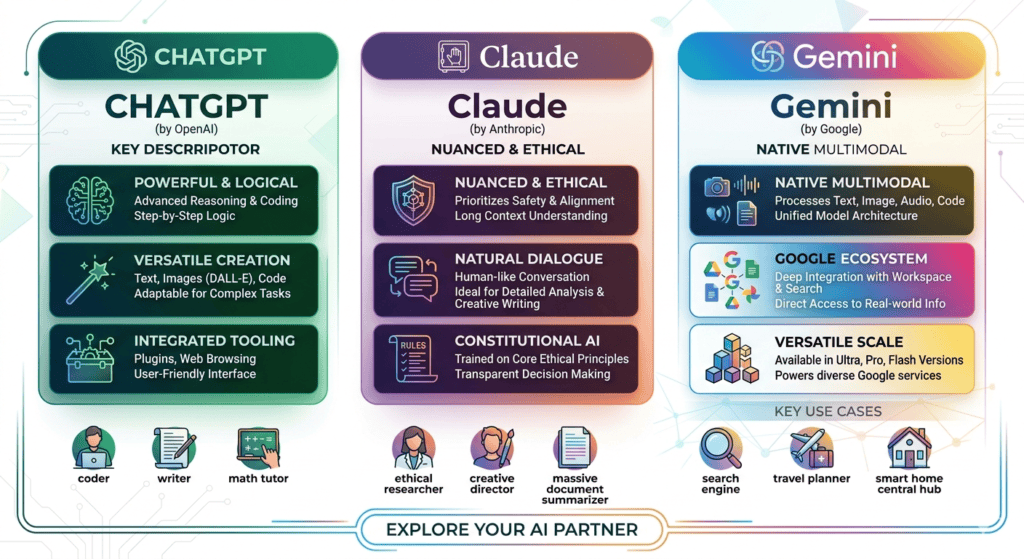

Here’s what surprised me most when I started seriously using all three: they’re not competing to be the same thing anymore.
A year ago, the question “which AI is best?” made sense. One model was clearly smarter than the others. You’d pick that one and you were done. But by June 2026, that changed. The gap between Claude Opus 4.8, ChatGPT (now GPT-5.5), and Gemini 3.1 Pro has shrunk so much that “best” doesn’t mean anything. What matters now is: best for what?
I use all three daily. Claude for writing and code. ChatGPT for workflows and automation. Gemini when I’m drowning in data. Each one excels at something different, and honestly, that’s how I work best.
If you’re trying to pick one, I get it—you want a simple answer. But the simple answer is outdated. Let me walk you through the real situation and what actually matters.
The Current State: June 2026
Let me be specific about what we’re comparing, because the model names are confusing now.
ChatGPT (OpenAI’s current version): GPT-5.5, released April 23, 2026. This is what most people use when they go to ChatGPT.com. It can handle text, images, audio, and video in one unified model—no separate processing layers for different media types.
Claude (Anthropic’s current flagship): Opus 4.8, released May 28, 2026. This is the top-tier model. If you’re paying for Claude Pro, this is what you get. There’s also Sonnet 4.6 (cheaper, still very good) and Haiku 4.5 (fast, lightweight).
Gemini (Google’s current version): Gemini 3.1 Pro, released in February 2026, with Gemini 3.5 Flash already available for faster, less complex tasks. Also Gemini 2.5 Pro with extended capabilities.
These are the main ones people compare. There are others (Grok, Perplexity, DeepSeek), but these three own most of the conversation.
The Surprising Truth: The Quality Gap Is Now Tiny
This is the biggest shift from even 12 months ago. On the major benchmarks, these three models are separated by single percentage points.
On the LMArena leaderboard (which ranks models by millions of blind human votes), Claude Opus 4.8 sits at around 1,510 Elo. GPT-5.5 and Gemini 3.1 Pro are within 50 points of that. A year ago? The gap between first and fifth place was several times wider.
What that means: you’re not choosing between “clearly best” and “okay.” You’re choosing between three very capable models with different strengths.
Where They Actually Excel (The Real Breakdown)
Benchmarks are one thing. Real-world performance is another. Here’s what I’ve observed using them on actual work:
Claude Opus 4.8: The Writing and Code Specialist
Claude produces the least “AI-sounding” prose of the three. Period. I’ve tested this repeatedly. When you need content that reads like a human wrote it—not generic, not formulaic, not padded with obvious AI transitions—Claude does it better.
On the technical side, Claude absolutely dominates coding. It scores highest on SWE-bench Pro (the hardest coding test), handles full-file refactors without losing context, and produces fewer hallucinations when working with large codebases.
I use Claude when:
- Writing matters (blog posts, emails, product copy)
- Code quality is non-negotiable (I’m shipping production code)
- I need to understand edge cases and handle uncertainty
- I’m working with long documents and need precision
The tradeoff: Claude is expensive. API costs are roughly double ChatGPT’s, sometimes triple depending on the task.
Coding example: I asked each model to refactor a 500-line Python file with architectural improvements. Claude’s output was cleanest and required the least review. ChatGPT’s had minor issues. Gemini’s was functional but verbose.
Writing example: I generated product descriptions for e-commerce. Claude’s sounded natural and specific. ChatGPT’s felt formulaic. Gemini’s was somewhere in between.
ChatGPT GPT-5.5: The Workflow and Integration King
ChatGPT’s real advantage isn’t raw capability—it’s everything around the model. The ecosystem is enormous. It integrates with thousands of apps through plugins. The Operator feature (OpenAI’s automation tool) can actually execute multi-step tasks across your digital life. Work features for teams are battle-tested.
GPT-5.5 specifically excels at:
- Agentic workflows (breaking complex tasks into steps and executing them)
- Mathematical reasoning and problem-solving
- Working as part of larger automated systems
- Speed (it’s generally faster than Claude on most tasks)
I use ChatGPT when:
- I need automation (call this app, then that app, then summarize results)
- I’m doing math-heavy analysis
- The task involves integrations with other services
- Speed matters more than perfection
The tradeoff: Writing quality took a step backward. OpenAI’s CEO admitted in January 2026 that they prioritized coding and math over prose, and it shows. Users prefer Claude for creative writing now.
Automation example: I set up a workflow where ChatGPT pulls LinkedIn posts I’ve interacted with, identifies themes, and generates content angles. This required tool orchestration and state management—exactly what GPT-5.5 handles best. Claude could do it, but the integration layer would be messier.
Gemini 3.1 Pro: The Scale and Multimodal Champion
Gemini’s biggest advantage is its context window: 1 million tokens. That’s roughly the equivalent of reading 500 pages of text in one conversation. Claude maxes out at 200K. ChatGPT at 256K.
Why does that matter? If you’re working with massive documents, datasets, or video/image-heavy projects, Gemini can handle them in one shot. You don’t need to break things into chunks.
Gemini also excels at:
- Processing images, PDFs, video simultaneously
- Handling large volumes of unstructured data
- Cost (it’s the cheapest of the three per token for high-volume work)
- Being integrated directly into Google Workspace (Gmail, Docs, Sheets actually understand your context)
I use Gemini when:
- I’m processing massive documents or datasets
- The task involves multiple media types
- Cost per token is a factor
- I’m already in Google Workspace and need Gemini’s integrations to work
The tradeoff: While Gemini has closed the gap significantly, it still doesn’t match Claude for pure writing quality or ChatGPT for orchestrated workflows.
Scale example: I needed to analyze 200+ research papers for a report. Claude would require multiple sessions and context management. Gemini ingested all of them in one conversation. The synthesis was excellent.
The Pricing Reality (This Matters More Than You Think)
Here’s where the comparison gets practical:
Consumer pricing (monthly subscriptions):
- Claude Pro: $20/month
- ChatGPT Plus: $20/month
- Gemini Advanced: $20/month
All the same. That’s not where the difference shows up.
API pricing (what you pay per use):
For a representative task (100,000 input tokens + 10,000 output tokens):
- Gemini 3.1 Pro: ~$0.40 (cheapest)
- ChatGPT GPT-5.5: ~$2.50 (middle)
- Claude Opus 4.8: ~$5.00 (most expensive)
Over a month of regular use, that difference compounds. Some teams report 70-80% cost savings by routing simple tasks to cheaper models and expensive tasks to better ones.
If you’re using these at scale—running hundreds of API calls—Gemini’s cost advantage becomes significant. If you’re a consumer paying monthly, they’re all equal.
Context Windows: Why It Matters (But Not Always)
Claude: 200K tokens standard (larger with caching) ChatGPT: 256K tokens Gemini: 1 million tokens
That’s a massive gap in Gemini’s favor. But it only matters if you actually use it. Most people don’t.
You need massive context windows if you’re:
- Analyzing entire books or technical documentation
- Processing video and extracting every frame
- Working with large datasets
- Building complex multi-file code projects
If you’re writing blog posts, handling customer support, generating copy, or doing most knowledge-work tasks? You’ll never hit those limits.
Benchmarks (What They Actually Show)
The official benchmarks put them within points of each other:
SWE-bench Pro (hardest coding test):
- Claude Opus 4.8: 88.6%
- Gemini 3.1 Pro: ~80.6%
- ChatGPT: ~80% (varies by version)
GPQA Diamond (PhD-level reasoning):
- Gemini 3.1 Pro: 94.3%
- Claude: ~91%
- ChatGPT: ~90%
Human preference ranking (LMArena):
- Claude Opus 4.8: ~1,510 Elo
- GPT-5.5: ~1,505 Elo
- Gemini 3.1 Pro: ~1,500 Elo
The clusters are so tight that real-world performance depends more on your specific task than on these aggregate numbers.
The Real Answer: Model Routing
The highest-leverage AI users I know aren’t locked into one platform. They use all three in combination, routing different work to different models.
Here’s what that looks like:
- Claude for: Writing, code quality, edge-case reasoning
- ChatGPT for: Automation, math, complex multi-step tasks, integrations
- Gemini for: Massive documents, multimodal work, cost-sensitive high-volume tasks
One team I know uses Claude for content creation (saves editorial time), ChatGPT for customer support workflows (automation matters), and Gemini for data analysis (price per token at scale).
They report cutting costs by 70-80% compared to using one model for everything, while actually getting better results because each task goes to its specialist.
For Different Use Cases: Quick Guide
If you’re a writer or content creator: Claude. It’s not close. Your editing time drops significantly.
If you’re building automations or workflows: ChatGPT. The integration ecosystem and agentic capabilities matter more than marginal improvements in base model quality.
If you’re drowning in data or working with massive documents: Gemini. The context window and multimodal handling are genuinely valuable. Cost is secondary.
If you code professionally: Claude first, ChatGPT second. Claude’s code quality and understanding of architecture are legitimately better. ChatGPT is strong but more prone to architectural misses on large projects.
If you’re evaluating for a team: Get subscriptions to all three. Let people use what they’re comfortable with. The cost is negligible ($60/month per person for all three Pro subscriptions). The productivity difference from matching the right tool to the right person is real.
If you have a limited budget: Gemini Advanced. Best value per token for general work. Not the best at any one thing, but solid at everything, and cheapest.
What’s Actually Happening Under the Hood
All three companies are making different bets about the future:
OpenAI’s bet: The future is execution. GPT-5.5 is positioned as a complete system for digital work—you don’t just ask questions, you delegate entire workflows. That’s why tool orchestration and state management matter so much.
Anthropic’s bet: The future is reliability. Claude isn’t racing to be first on every benchmark. It’s racing to be the model you trust with high-stakes work. Coding, writing, reasoning—places where being wrong is expensive.
Google’s bet: The future is integration. Gemini isn’t trying to be the smartest model in a chat window. It’s trying to be the AI layer running inside your actual work tools—Gmail, Docs, Sheets. Context matters less than integration depth.
These are three different visions of what AI should do. None is wrong. They’re just different.
The Honest Comparison
If I had to summarize:
Claude Opus 4.8 wins on: Writing, coding, reasoning, least “AI-sounding” output ChatGPT GPT-5.5 wins on: Automation, integration, ecosystem, speed Gemini 3.1 Pro wins on: Context window, multimodal, cost per token, Google Workspace integration
If forced to pick one and keep only one? Claude. It has the highest floor—it’s genuinely good at most tasks, and exceptional at the work I do (writing and code).
But the real answer is that 2026 is the first year where the answer is “it depends” and that’s actually right.
What’s Coming
Claude Opus 5 is rumored for Q3 2026. GPT-5.5 will get updates. Gemini will push further on multimodal and context. Agent mode (where AI takes autonomous actions on your behalf) is becoming standard across all three.
The real competition is no longer “which is smartest.” It’s “which fits your workflow best” and “which ecosystem works with your other tools.”
That’s a healthier competition. It means there’s no single “best” and never will be. You’ll pick based on what actually matters for your work.
The models have converged. The differentiation has shifted to ecosystem, pricing, and integration. That change happened faster than I expected, but it’s here.
